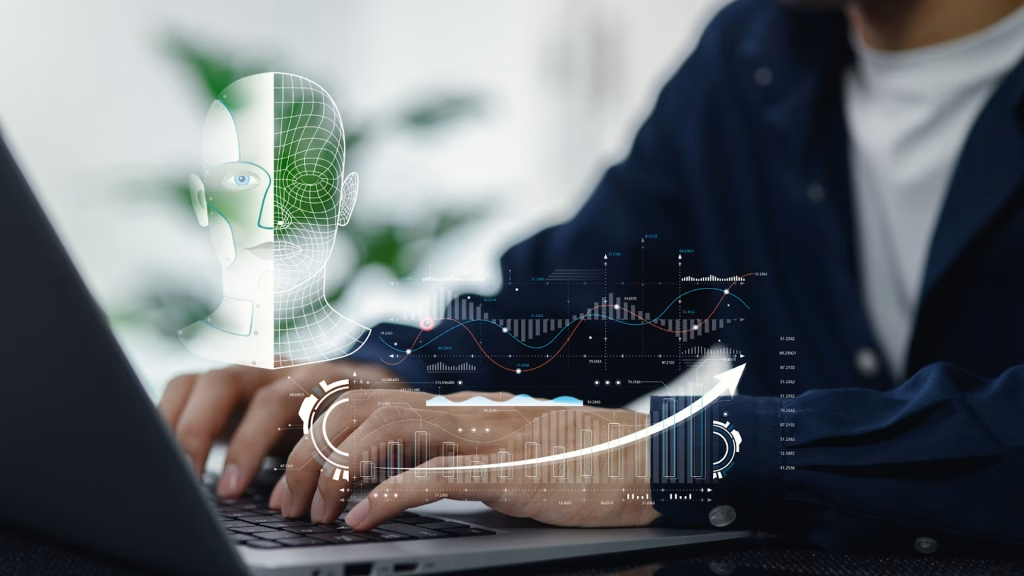
The importance of mentorship has always been an integral part of both personal and professional development. With the help of the proper mentorship, you will have a chance to develop professionally. Traditionally, mentorship involved working with a senior colleague and learning from the teacher, as well as having sessions in which career advisors were involved. They carried the knowledge, experience, and the innate sense to enable the mentees to make tough career decisions.
However, in the modern age of technology, artificial intelligence, as well as the automation of mentorship, has evolved and assumed a new form. Nowadays, AI-based applications have been created that provide personalized career advice, enable conversations with coaches, and analyse career paths with unbelievable speed and accuracy. We must ask ourselves, is it possible that AI can really substitute human career coaches? Let’s look at the potential and drawbacks of this advancing modern-day form of mentorship.
What is AI Mentorship
AI mentorship refers to the use of artificial intelligence software and technologies to offer support in career development/advice. Unlike the conventional one-on-one interaction with a person, in this case, the users are interacting with algorithms that promote the creation of mentors based on data-driven information.
These artificial intelligence systems utilise machine learning to process information about the user, such as experience, work history, desires, and goals, and propose custom actions. As time goes on, and the users engage more with these systems, they become educated and offer more accurate advice.
AI mentorship is already used in the majority of popular platforms. Online career counselors are integrated on these sites both into the learning management software and also job portals, where they offer personalized advice. Social networking sites like Careervira are providing a job explorer page where the user can search through career options via AI-based tests to match their skills and interests with market demands.
AI vs Human Mentors: The Major Differences
When making comparisons between AI and human-guided mentors, it is crucial to recognize where each excels and where they fall short. In this section, the slight difference between the artificial and the human-directed guidance will be discussed.
1. Empathy and Emotional Intelligence: Human mentors add emotional depth. They are attentive and act with empathy and frequently help make emotional, non-linear career decisions. AI, although it is developing in the field of neural language processing, isn’t able to replicate human emotion. It’s not yet able to mimic the reassurance of a teacher’s nod of understanding or calm tone.
2. Availability, Scalability, and Personalization: AI shines in terms of accessibility. It’s always available, scalable to millions of users at a time, and can personalize feedback in response to a broad range of information inputs. Human coaches, even when they are at their best, can be a bit slow and have cognitive limitations.
3. The Data Driven Model Versus: The use of Intuitive Guidance AI coaches is based on huge patterns, data, and even statistical algorithms. They can give data-supported recommendations faster than human beings could. Nevertheless, human coaches depend on their intuition that was developed throughout their lives–a thing that a machine can hardly copy.
The Real Life Workings of AI Career Coaches
A graduate who is not certain of the path to follow in his/her career might turn to the services of mentors. Of course, they register on an online career development site and answer a set of questions. The AI engine then evaluates their responses and juxtaposes them with data on the labor market, and provides potential careers such as digital marketing, data analytics, and UX design.
It is also steered by personal training journeys, suggests qualifications, and even conducts a skills gap analysis. Users are encouraged to send resumes to be reviewed, and this undergoes scrutiny by AI to draw improvement. In time, the applicant receives feedback loops that highlight the things they’ve accomplished well and how they could do better.
These AI professional mentorship platforms aren’t static. They change. To illustrate the point, in case a student starts an online course, the system might recommend other related skills or concepts to do side-projects in order to create a more powerful portfolio.
Careervira’s course section is based on AI recommendations to help students identify the most relevant classes based on their needs and the current skills they possess.
Benefits of AI Mentorship

One unanswered question is the reason why both learners and students alike are embracing AI mentoring tools at such an accelerated rate. This question will be answered in this article, and the significant advantages will be described.
1. Human-Based Coaches: Can be expensive because of their cost and 24-hour availability. Also, AI mentorship platforms offer continuous support at a fraction of the price, so mentoring can be affordable to organizations and individuals with limited funds.
2. Scalability for Remote and Enterprise Teams: With remote teams and distributed teams, hybrid work being the norm, AI mentors can support thousands of employees at the same time. Businesses can automate learning journeys and deliver customized upskilling delivery without eating up human capital. This is why tools such as Careervira’s Enterprise Solutions step in to deliver an upskilling solution that is scalable and based on data for companies.
3. The factual and objective recommendation: AI does not have an unconscious bias in the conventional meaning (though that is yet to be seen in the future). It cleans data and provides the roles, capabilities, and learning pathways without subjective determinations, helping users to concentrate on growth areas.
Limitations & Ethical Concerns
Even though AI mentorship is not the best, it has its advantages. The potential dangers and drawbacks of choosing to leave your job to the robots are described in this article.
1. Security of Data as well as Algorithmic Bias: AI systems depend heavily on user data. This poses serious concerns regarding how data is kept, who is able to access this data, and which security measures have been put in place. Also, in case the learning data is either biased or biased, the AI may unintentionally form inequalities.
2. AI Cannot Replace the Emotional: Resonance of human inspiration or the motivation found in a truly invested teacher. It has to deal with subtleties, such as managing rejection, career anxiety, or issues with confidence.
3. Reliance Too Much on Automation: Risks of users relying on AI recommendations in blind faith. Even though AI provides recommendations with the use of data, it does not necessarily reflect the realities of family life, individual preferences, or choices in favor of work-life balance.
Who Are AI Mentors
There are many who require the same amount of career direction. Some individuals are fed by AI recommendations, but others are in need of the stability of human knowledge. This part is devoted to the most benefited people.
1. Students and early-career professionals: AI mentors can provide low-cost and on-demand support to students and early-career professionals starting their careers. They receive organization, professional recommendations, and career mapping.
2. Career Switchers: Mid-career professionals usually pursue new opportunities. Being career coaches is a fantastic method of serving as mentors with AI to enable career changes. They will be able to help in the analysis of transferable skills and prescribe courses and jobs to facilitate the transition.
3. HR and Enterprise Teams: The HR and enterprise teams can make use of AI to monitor the learning of employees, spot the most promising talent, and close gaps in their skills. It’s an exciting way to manage the development of workers at a large scale.
Human career coaches are more suitable in cases where major transitions in life or when complex and emotional decisions are necessary, or when strategic leadership coaching is necessary.
The Prospects of AI in Career Coaching
What will become of career coaching? The following step in innovation will be discussed in this section.
It is probable that the future does not belong to humans or AI but to both. When AI can perform data-intensive routine jobs and human coaches can offer the richness of emotional insight and strategic approach, a hybrid model will prevail.
An example of this is that AI can determine that the employee has not mastered the field of data analysis, suggest three courses that will be pertinent, and establish a 6-month plan. A human coach can help adjust this plan to the goals of the person in the future or provide their advice on how to maneuver the dynamics of the workplace.
We will also observe the use of AI in education-to-employment pipelines, which would assist students in their smooth transition into the workforce. AI will guide students to select subjects as well as internships, projects, and other courses that are in line with the most sought-after jobs.
Though AI is still developing, it will become conversant, more sensitive, and more skillful to imitate human interactions. Although it will not displace humans in any manner, AI will boost its own abilities. Therefore, the next thing that professionals are supposed to do is to enhance their skills and learn to use AI.
Conclusion
There isn’t a single industry that is not impacted by the power of artificial intelligence. This implies that AI mentorship is here to remain, and it has many benefits, including 24×7 access, affordable and scalable, highly customized information. It is ideal for guided learning, everyday guidance, or a career map.
The question is, would a robot be a career coach to you? Yes, a human being at the other end of the line is a good answer. AI mentoring will be the first step to self-discovery and will provide clarity and direction. When combined with human experiences, it is able to transform the concept of mentorship. The most important thing about leveraging mentorship to its maximum would be to know when you can have an AI and when you need to consult humans.